Channel design
Choose a channel by the work it changes.
Email stores work. Chat shares live attention. Phone creates a real-time line. Messaging persists across pauses. Voice AI adds an automated real-time system. Each needs a different staffing model, queue, promise, workflow, and quality standard.
Compare the channels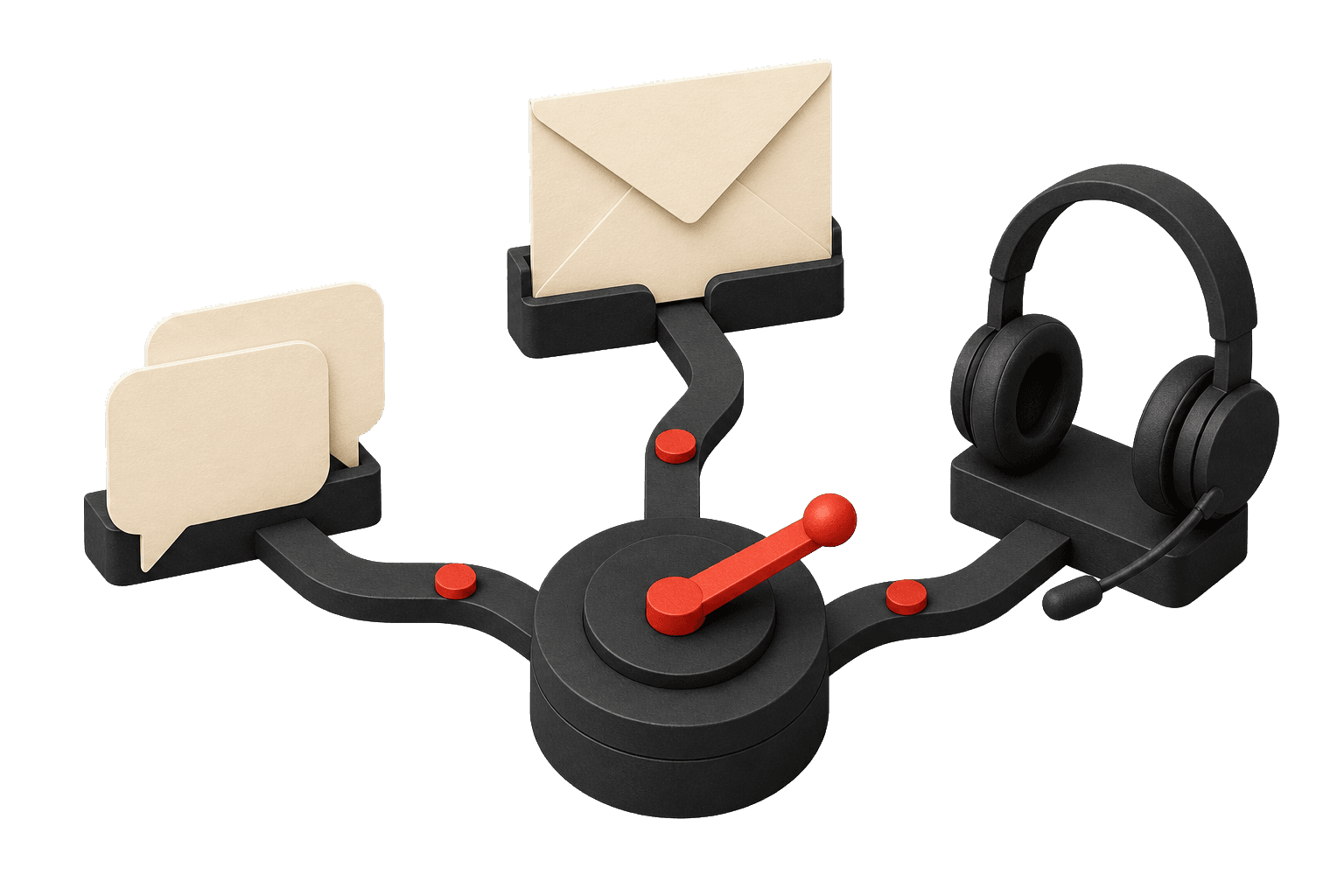
Adding an inbox, launcher, or number is the easy part. The operating commitment begins when a customer believes someone is available on the other side.
Five operating models
Start with the channel you run—or the one you are considering.
Asynchronous channel playbook
Email customer support
A practical operating playbook for asynchronous written support: set customer expectations, forecast workload, control backlog and work in progress, define meaningful service levels, review quality, and preserve context from receipt through durable resolution.- Problems that benefit from screenshots, logs, order details, or a written record
- Requests where the customer and agent do not need to be present at the same time
- Work that requires investigation across teams or systems
Synchronous messaging playbook
Live chat customer support
A practical playbook for staffing interval demand, setting safe concurrency, controlling wait and abandonment, designing the conversation flow, preserving quality, and converting gracefully to asynchronous help when the problem outlives the session.- Customers who need quick clarification while completing a task
- Problems that can be diagnosed through short, interactive exchanges
- In-product or web journeys where relevant context can travel with the conversation
Real-time voice playbook
Phone customer support
A practical operating playbook for interval forecasting, queueing and callback, real-time voice workflows, verification, hold and transfer, QA, accessibility, escalation, telephony controls, and the service measures that reflect the whole call.- Urgent or high-impact problems where the customer needs immediate reassurance and guided action
- Complex diagnosis that benefits from natural back-and-forth and clarification
- Emotionally sensitive situations where tone and listening materially affect recovery
Persistent conversation
Messaging support
Operate WhatsApp, SMS, and in-app messaging as persistent conversations with explicit response promises, identity, consent, context, queue ownership, and a clean path between asynchronous and live attention.- Customers who need to leave and return without losing the thread
- Mobile-first service, notifications, simple transactions, and status updates
- Conversations that begin asynchronously but may become live
Real-time automated conversation
Voice AI support
Design AI voice support as a real-time production service with disclosure, turn-taking, identity, bounded actions, evaluation, monitoring, human transfer, and a circuit breaker—not as a talking FAQ.- Narrow, frequent, well-understood calls with authoritative data and actions
- Status, scheduling, simple account service, routing, and after-hours triage
- Callers who choose speech and benefit from immediate turn-by-turn help
Side by side
One support problem, five different capacity systems.
Use the matrix to choose an operating model, not to declare one channel universally better. Customer need, accessibility, urgency, evidence, complexity, and affordable coverage all matter.
| Design question | Live chat | Phone | Messaging | Voice AI | |
|---|---|---|---|---|---|
| Interaction mode | Asynchronous written conversation | Synchronous or near-synchronous text conversation | Synchronous one-to-one voice conversation | Persistent, usually asynchronous conversation that may become near-real-time while both sides are present. | Synchronous spoken conversation mediated by speech recognition, orchestration, tools, generation, and speech synthesis. |
| Best customer use | Detailed, non-immediate, documented problems | Immediate clarification and guided task completion | Urgent, complex, sensitive, or difficult-to-write problems | Mobile status, coordination, simple transactions, follow-up, and support that survives interruptions. | Immediate spoken help for bounded tasks, status, routing, scheduling, and guided actions. |
| Demand pattern | Stored work; bursts become backlog rather than an occupied line | Interval-sensitive; customers wait, abandon, or retry when capacity is unavailable | Interval-sensitive; callers wait, abandon, retry, or choose callback | Message events arrive continuously; one customer conversation can re-enter after minutes, hours, or days. | Queued real-time calls with peaks, abandonment, retries, transfers, and possible overflow from human lines. |
| Capacity unit | Messages or cases × active handling and follow-up effort | Concurrent active sessions adjusted for complexity and agent attention | One active call per agent plus hold, transfer, and after-call work | Conversation workload by response window, active state, message turns, and skill—not raw message count. | Concurrent calls constrained by telephony, model throughput, tool latency, rate limits, and human fallback capacity. |
| Queue behavior | Inventory accumulates across states and age bands | Visible waiting line plus active conversations and post-chat work | A perishable waiting line managed through routing, announcements, and callback | Threads persist and reopen; inactivity is not the same as resolution, and channel windows can expire. | Callers wait or abandon before connection; during the call every pause, failure, and transfer is experienced in real time. |
| Concurrency | Many cases can be open, but active work in progress must stay bounded | Usually greater than one, but safe level changes with task and customer state | One live customer conversation per agent | Several conversations are possible, but active bursts and complex work compete for attention unpredictably. | The system can serve many calls, but each requires an independent low-latency path and reserved human escalation capacity. |
| Service promise | Meaningful response and next-update commitments in business or calendar time | Time to acceptance, active response cadence, and a clean path to resolution or follow-up | Access to a qualified person, honest wait, call continuity, and owned follow-up | A clear first-response window plus an explicit change when the conversation becomes live, pending, or closed. | Immediate disclosure, fast turn response, bounded capability, a reachable human, and no lost context at transfer. |
| Strongest evidence | Thread, attachments, timestamps, case history, and written decision trail | Transcript, event timeline, page or product context, and transfer history | Audio, transcript, call events, verification, hold, transfer, and case notes | Durable resolution, response-window attainment, repeat contact, handoff quality, and consent or delivery reliability. | Confirmed task completion, critical-error rate, latency, repeat contact, transfer recovery, unauthorized-action rate, and complaints. |
| Primary failure mode | Long silence, fragmented ownership, or fast replies that create extra rounds | Attention fragmentation: slow gaps, shallow replies, missed details, and cold handoffs | A long or confusing queue followed by repeated explanation, cold transfer, or incomplete follow-up | An apparently convenient channel becomes an ownerless stream of delayed fragments, repeated identity checks, and silent closure. | A fluent agent appears capable, acts outside authority, or loops while the caller has no reliable escape to a person. |
Before adding a channel
Make four decisions the software cannot make for you.
- 01
Which customer problem improves here?
Name the need, urgency, evidence, and interaction pattern. A channel without a distinct job usually shifts demand instead of improving service.
- 02
What availability are you promising?
Define hours, languages, skills, wait, response, follow-up, and the experience when capacity is unavailable.
- 03
How will context survive the boundary?
Preserve identity, history, evidence, promises, and ownership when a customer or operator moves between channels.
- 04
Which paired measures protect quality?
Read speed and utilization beside resolution, repeat contact, accessibility, quality, and customer effort.
The shared foundation
Channels differ. The operating discipline does not.
Define the service, model real capacity, make ownership visible, design escalation, protect accessibility, and review whether the customer's problem stayed solved.