Queue time vs handle time
Support obsesses over handle time because it sets the budget. But the wait customers actually resent happens before an agent ever picks up — and squeezing the wrong clock makes both worse.
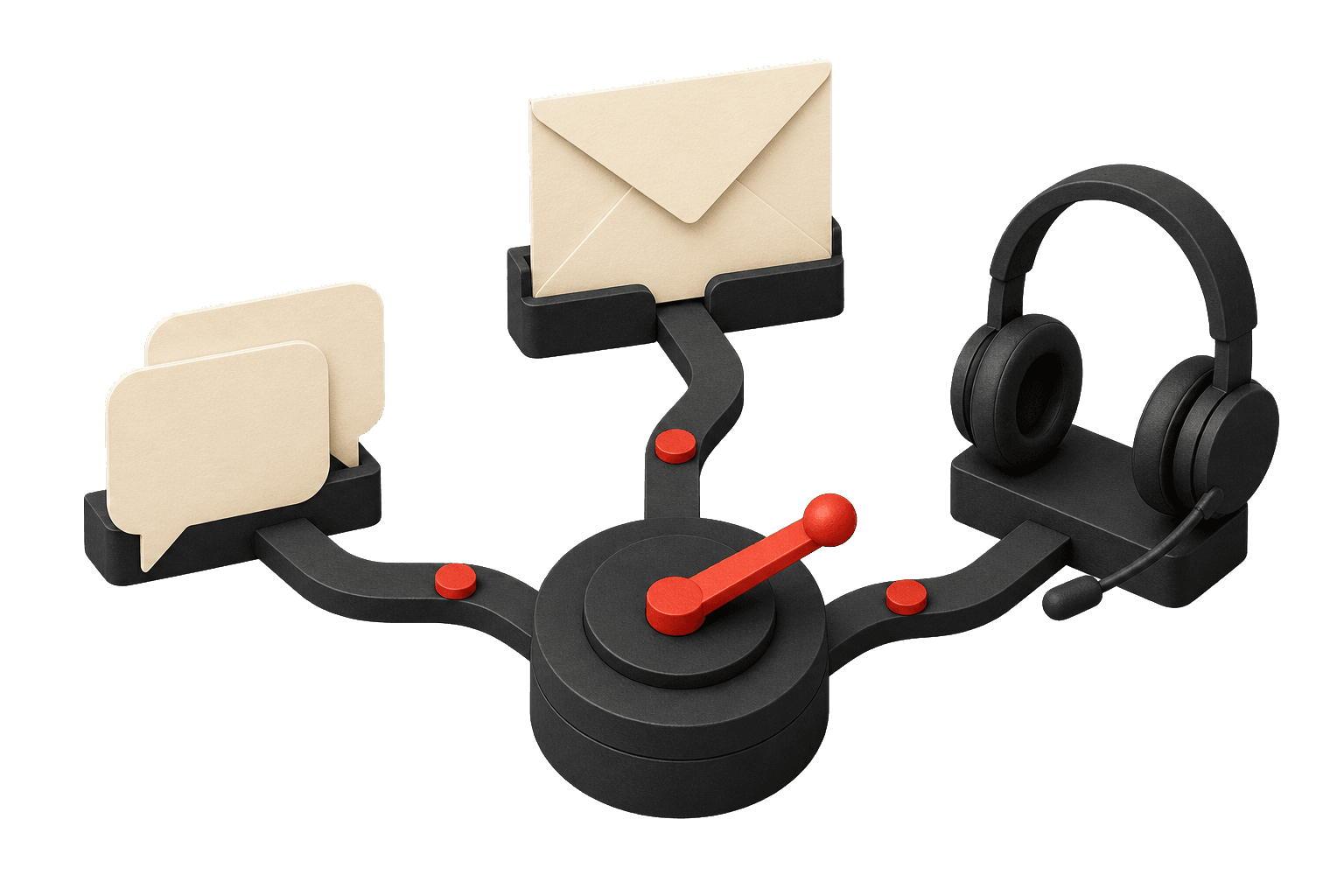
A team lead trims average handle time by thirty seconds and sends a note round to celebrate. Meanwhile the customer whose problem started the whole thing has been listening to hold music for nine minutes. She will never learn how efficient the agent was once he finally picked up. She only knows how long she waited for him to.
Two clocks, one contact
Every support contact runs two clocks. Handle time is how long an agent spends working an issue once it reaches them — talking, typing, wrapping up. Queue time is everything before that: the minutes a customer waits for anyone to pick up at all. They are tracked separately for good reason. They move on different levers, and only one of them is felt by the person you are serving.
Average handle time dominates dashboards because it sets the budget: seconds per contact times contact volume gives you headcount. That is why management attention pools around it — handle time is a budgeting metric first and a customer metric a distant second. The industry-standard figure, drawn from more than 190,000 staffing calculations, lands at about six minutes.
The customer never experiences those six minutes as the problem. What they experience is the queue — the wait before the six minutes even begins. The oldest promise in the contact center is a queue-time promise, not a handle-time one: answer 80% of contacts within 20 seconds.
Where the frustration actually lives
Ask customers where a support experience went wrong and they point at the waiting — and they mean the queue. It is the visible, uninterrupted, powerless part, and it is where people quit. In one 400-person patience survey, three-quarters of callers hung up once hold time crossed eight minutes.
Nobody abandons because the handling was thorough; they abandon because the line was long. The wait that drives abandonment and sours the whole interaction is the one before contact — precisely the wait AHT cannot see. It is also the wait that feels longer than it is: an open-ended, unexplained hold distorts a person's sense of time far more than a slow but active conversation.
Why squeezing handle time backfires
Here is the trap. Queue too long? Cut handle time, free up capacity, drain the queue. It sounds like arithmetic. It fails twice over.
First, queue time is governed by staffing and occupancy, not by how fast agents talk. This is Erlang math: as occupancy climbs, wait times don't ease down gently — they spike. The practical ceiling professionals set is about 83%.
Run hotter than that to squeeze the queue and you buy volatility and burnout, not a shorter line.
Second, rushed handling breaks resolution. First-contact resolution already sits around 70–75%, so a quarter of contacts fail the first time even at a normal pace.
Push agents to close faster and that share grows — and every unresolved issue returns as a reopen, which is a brand-new arrival in the very queue you were trying to shorten. Shaving handle time to fix queue time can lengthen the queue.
The customer never feels your handle time. They feel the queue — and the queue is where they quit.
Optimize the wait they feel
The answer isn't a faster stopwatch on agents. It's managing the two clocks for what they are. Staff to a service level, not to a handle-time target, so the queue becomes a design decision instead of a byproduct. When you can't add coverage, manage the queue directly: a scheduled callback takes people off hold entirely, and most of them prefer it — three in four say they would rather be called back than wait.
And stop reporting an average response time that hides the long tail where customers actually leave.
Handle time tells you what a contact costs to run. Queue time tells you what it cost the customer to reach you. Optimize the first and you protect a budget. Optimize the second and you protect the relationship. Confuse them — squeeze the number the customer can't feel to rescue the one they can — and you make both worse.